



Pipeline
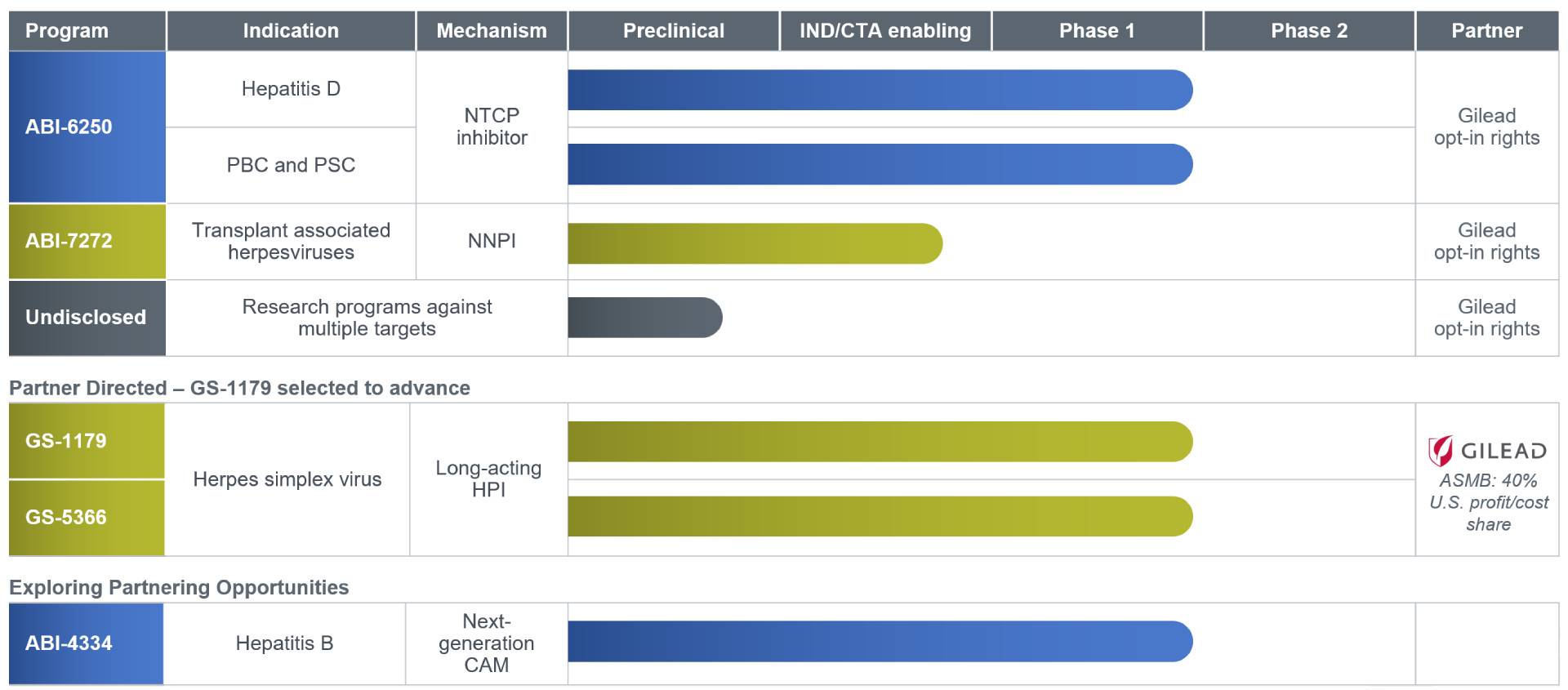
Our pipeline includes clinical development stage candidates for the treatment of recurrent genital herpes, chronic hepatitis delta virus (HDV) infection, cholestatic liver diseases and chronic hepatitis B virus (HBV) infection. Our research programs focus on the discovery of additional novel small molecules for the treatment of serious viral and liver diseases.
GS-1179 and GS-5366 (formerly ABI-1179 and ABI-5366)
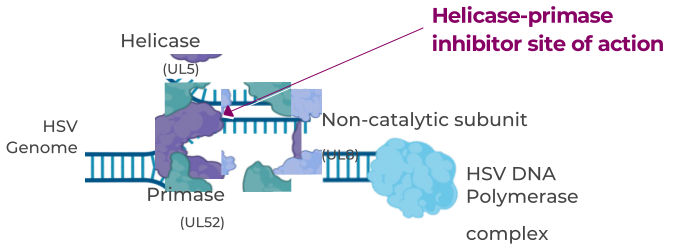
GS-1179 and GS-5366 are HSV helicase-primase inhibitors targeting the helicase-primase complex, an essential viral enzyme complex that is conserved across both HSV-1 and HSV-2 and has no host equivalent. Inhibition of the helicase-primase complex is a clinically validated mechanism that has shown the potential for superior efficacy to nucleoside analogs in short-duration clinical studies in individuals with recurrent genital herpes. Both GS-1179 and GS-5366 were developed as long-acting agents for recurrent genital herpes targeting once-weekly or longer oral dosing intervals.
In the completed Phase 1a/b studies, both GS-1179 and GSI-5366 showed statistically significant reductions in shedding rate and genital lesion rate compared to placebo over 29 days, with pharmacokinetic profiles supportive of once-weekly dosing – and, for GS-5366, the potential for once-monthly oral dosing.
In December 2025, Gilead Sciences, Inc. exercised its option to exclusively license Assembly Bio’s HSV helicase-primase inhibitor program under the companies’ ongoing collaboration agreement. Gilead has elected to advance GS-1179 into a Phase 2 study in individuals with recurrent genital herpes. GS-5366 remains exclusively licensed to Gilead.
Recurrent genital herpes
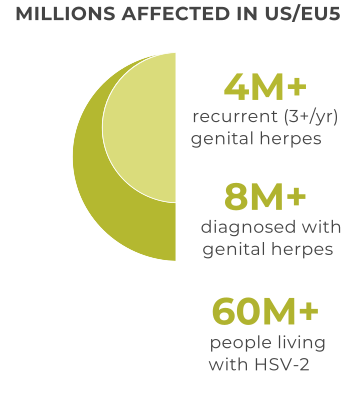
Recurrent genital herpes is a disease caused by herpes simplex virus (HSV) infection that can result in painful genital lesions, serious psychological and social impacts, and an increased risk of acquiring human immunodeficiency virus (HIV). It is estimated that over 4 million individuals in the US and EU5 are affected by recurrent genital herpes. While genital herpes can be caused by either HSV-1 or HSV-2, recurrences are more likely to be experienced by individuals infected by HSV-2. Most individuals with initial symptomatic genital HSV-2 infection have three or more recurrences per year, with painful lesions, lymphadenopathy and urinary problems that can last for 2-3 weeks per recurrence. The current standard of care for recurrent genital herpes is daily chronic suppressive therapy with nucleoside analogs; however, these are only partially effective in preventing recurrences with only 1 in 3 individuals achieving prevention of recurrence. No new drugs have been approved in the United States or Europe to treat genital herpes for more than 25 years.
ABI-6250
ABI-6250 is an oral, small molecule inhibitor of NTCP, a membrane protein selectively expressed on hepatocytes that facilitates bile acid transport into cells and also serves as the entry receptor for hepatitis delta virus (HDV) infection. ABI-6250 is in development for the treatment of chronic hepatitis delta virus (HDV) infection as well as cholestatic liver diseases.
For chronic HDV infection, the targeting of NTCP by ABI-6250 blocks viral infection, which is a clinically validated mechanism. High preclinical potency has been observed with ABI-6250 against multiple HDV strains.
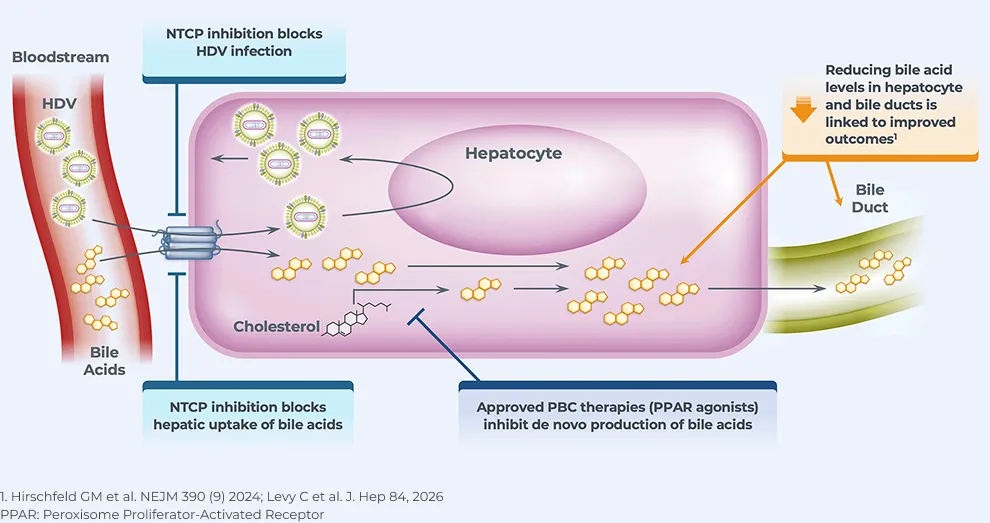
For cholestatic liver disease, the targeting of NTCP by ABI-6250 blocks the uptake of bile acids into liver cells, a mechanism directly relevant for cholestatic liver diseases, where bile acid accumulation drives liver inflammation and liver injury.
A Phase 1a study with ABI-6250 in healthy individuals demonstrated a 4-day half-life, supportive of once daily oral dosing. Further, dose-dependent elevations in plasma total bile acids were observed, indicating ABI-6250’s engagement with NTCP, the receptor used by bile acids and HDV to enter hepatocytes.
Chronic hepatitis D virus infection
Chronic hepatitis delta virus (HDV) infection is a serious, life-threatening disease that impacts an estimated 12 million individuals worldwide. HDV is a satellite virus that only infects individuals already living with chronic HBV. Coinfection with HDV and HBV increases an individual’s disease burden compared to being infected with HBV alone, with HDV being considered the most severe form of chronic viral hepatitis. Treatment options for individuals with chronic HDV infection are limited; currently, the only approved treatment in certain countries is a large molecule NTCP inhibitor that requires daily injection and cold storage.
Cholestatic liver disease
Cholestatic liver diseases are progressive diseases that cause liver damage and fibrosis due to the build up of bile acids in liver cells. Primary biliary cholangitis (PBC) and primary sclerosing cholangitis (PSC) are two major types of cholestatic liver diseases. PBC predominantly impacts adult women and the estimated prevalence rate is 14.60 per 100,000 individuals/ year. Despite the availability of first and second line treatments for PBC, these therapies are suboptimal and there remains an unmet medical need. PSC predominantly impacts younger adult males and the estimated prevalence rate is 0-31.7 per 100,000 individuals/ year. For PSC, there are currently no approved therapies.
ABI-4334
ABI-4334 is an oral, small molecule next generation capsid assembly modulator in development for the treatment of chronic hepatitis B virus (HBV) infection. ABI-4334 has been optimized to potently disrupt both viral replication as well as replenishment of new covalently closed circular DNA (cccDNA), the viral reservoir that drives HBV persistence.
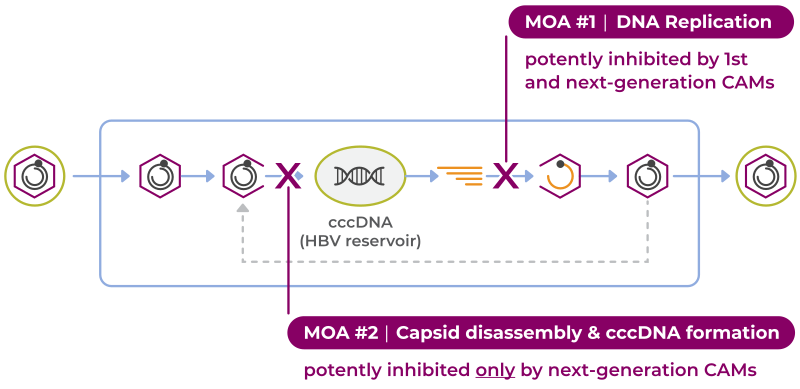
In a completed Phase 1b study of ABI-4334 in individuals with chronic HBV infection, ABI-4334 showed a favorable safety and tolerability profile with a pharmacokinetic profile supportive of once-daily oral dosing. Potent antiviral activity was observed as measured by reductions in HBV DNA.
Chronic hepatitis B virus infection
Chronic hepatitis B virus (HBV) infection is a debilitating disease of the liver that afflicts approximately 240 million individuals worldwide. HBV infection is the leading cause of chronic liver disease and the need for liver transplantation, with up to 1.1 million deaths due to HBV-related causes per year. The current standard of care for people with chronic HBV infection is life-long suppressive therapy, which reduces but does not eliminate HBV, resulting in very low cure rates.
Research and discovery programs
Assembly Bio has multiple research programs focused on the discovery of additional novel therapies to target serious viral and liver diseases, including a program focused on discovering a broad spectrum non-nucleoside polymerase inhibitor for the treatment of transplant-associated herpesvirus infections.
More information about our clinical trials can be found on our Clinical Studies page.